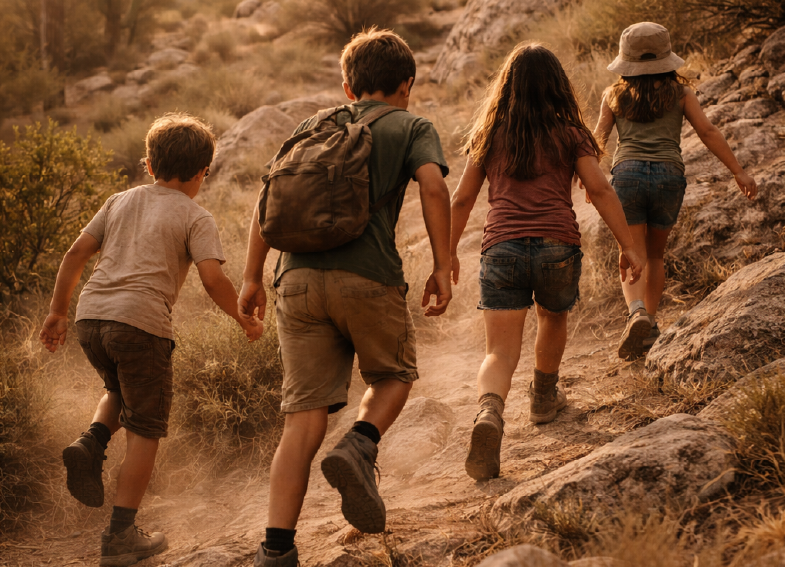
There was a time when children disappeared outside and came back dirty, hungry, and glowing.
No one knew exactly where they’d been.
No one tracked their steps.
No one curated the experience.
They climbed things. They made up rules. They got bored enough to invent entire worlds. They solved small problems without adults hovering nearby.
They were, by today’s standards, feral.
And they were thriving.
Feral doesn’t mean neglected.
It doesn’t mean unsafe.
It doesn’t mean uninvolved parenting.
It means unscripted.
It means children having enough freedom to test their bodies, their boundaries, and their imagination without constant adult direction. It means learning the world through experience instead of explanation.
Feral children are not wild because they lack care.
They’re wild because they’re trusted.
Modern childhood is often a perfectly engineered system.
Activities are scheduled. Risks are minimized. Boredom is treated like a problem to solve. Adults intervene quickly—sometimes too quickly—to smooth discomfort, prevent failure, or optimize outcomes.
The intention is love.
The result is often fragility.
When children are constantly managed, they don’t learn how to manage themselves. When every moment is filled, they don’t learn how to listen inward. When adults solve every problem, children don’t get the chance to discover their own capability.
Nature is unpredictable in the right ways.
It presents challenges without instructions. It offers risks that are real but manageable. It invites movement, creativity, and collaboration without enforcing rules.
Outdoors, children naturally:
They fall. They adapt. They try again.
And importantly, they do this without being evaluated.
One of the first things parents notice when kids are unplugged in nature is resistance.
“I’m bored.”
“There’s nothing to do.”
This is not a failure.
It’s the threshold.
Boredom is the nervous system resetting. It’s the space where imagination wakes up. If adults don’t rush in to fix it, something remarkable happens—children begin to create.
Games emerge. Stories form. Objects become tools. The environment becomes alive.
This is where feral magic lives.
When kids are given room to roam—physically and psychologically—they learn things no lesson plan can teach.
They learn:
They also learn that they are capable of navigating the world—not perfectly, but sufficiently.
That lesson stays with them.
Raising feral children requires something difficult from adults: restraint.
It asks parents to tolerate mess, uncertainty, and minor discomfort. To resist the urge to control outcomes. To trust that children don’t need constant direction to grow well.
This doesn’t mean absence.
It means presence without interference.
Watching instead of managing.
Listening instead of fixing.
Holding the boundary of safety while leaving the rest open.
In a world that increasingly values compliance, speed, and optimization, feral children grow into adults who can think for themselves.
They know how to explore without fear.
They know how to be alone without panic.
They know how to adapt when conditions change.
These are not soft skills.
They are survival skills.
Feral children aren’t behind.
They’re ahead.
They are learning the world the way humans always have—through dirt, curiosity, risk, and imagination.
And sometimes, the most loving thing a parent can do is step back, open the door, and let them run.

